


Popular Products


Popular Products
Fulling Mill
Masterclass Nylon Tippet
Description
Drawn from premium-grade Japanese nylon stock with the same German precision engineering behind the fluorocarbon, the Masterclass Nylon knots cleanly, seats without slipping, and carries the interlocking spool system and tangle-free retaining band across the range.
Fulling Mill Masterclass Nylon has been engineered with a lower density than its fluorocarbon counterpart which means it sinks slowly, keeping emerger and dry fly presentations riding higher in the column for longer. The suppleness of the Masterclass formulation is worth noting — it transmits the natural movement of the fly rather than dampening it, which matters on flat-water situations where presentation mechanics are the difference between a take and a refusal.
It's also the sensible choice for shallow, weedy reservoirs where you need to keep flies from fouling on the bottom and natural presentation close to the surface is the priority.
Features
- Material: Premium-grade Japanese nylon monofilament
- Construction: German precision-engineered; high knot strength
- Density: Low-density formula — slower sink rate keeps flies higher in the water
- Technique suitability: Dry fly, emerger, washing line method, suspended buzzer and nymph rigs
- Spool: Interlocking spool system with tangle-free retaining band
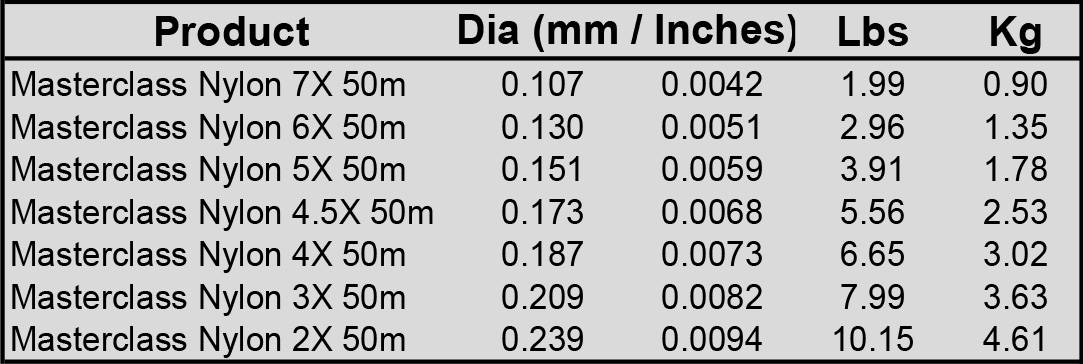
- Sizes: 2X - 7X *more details below
Details
FAQ: Fluorocarbon or Nylon — which tippet do I need?
When should I use fluorocarbon tippet? Reach for fluorocarbon when invisibility and sink rate are the priority — subsurface nymphing, streamer fishing, and any situation where the tippet is in the water column and fish are likely to inspect it. Fluorocarbon's low refractive index makes it near-invisible underwater, and its higher density pulls flies into the feeding zone faster.
When should I use nylon tippet? Nylon is the right call when you want your fly to stay on or near the surface. Its lower density slows the sink rate, keeping dry flies, emergers, and suspended nymph rigs — washing line method included — riding higher in the column for longer. It's also more supple than fluorocarbon, which gives surface flies a more natural drift.
Can I use fluorocarbon for dry fly fishing? You can, but nylon is generally the better choice. Fluorocarbon's higher density works against you on the surface — it generates more tension in the film and pulls flies down faster than nylon does.
Can I use nylon for nymphing? Yes, though fluorocarbon is usually preferred for sub-surface work. If you're fishing the washing line method or suspending buzzers just under the film, nylon's slower sink rate is actually an advantage. For deep nymphing with heavy tungsten, fluorocarbon gets the fly down faster.
Does tippet diameter matter as much as material? Both matter. A finer diameter in either material presents more naturally and improves drift, but finer means lower breaking strain — so match your tippet size to the fly size and the fish you're targeting, not just the presentation you want.
Drawn from premium-grade Japanese nylon stock with the same German precision engineering behind the fluorocarbon, the Masterclass Nylon knots cleanly, seats without slipping, and carries the interlocking spool system and tangle-free retaining band across the range.
Fulling Mill Masterclass Nylon has been engineered with a lower density than its fluorocarbon counterpart which means it sinks slowly, keeping emerger and dry fly presentations riding higher in the column for longer. The suppleness of the Masterclass formulation is worth noting — it transmits the natural movement of the fly rather than dampening it, which matters on flat-water situations where presentation mechanics are the difference between a take and a refusal.
It's also the sensible choice for shallow, weedy reservoirs where you need to keep flies from fouling on the bottom and natural presentation close to the surface is the priority.
Features
- Material: Premium-grade Japanese nylon monofilament
- Construction: German precision-engineered; high knot strength
- Density: Low-density formula — slower sink rate keeps flies higher in the water
- Technique suitability: Dry fly, emerger, washing line method, suspended buzzer and nymph rigs
- Spool: Interlocking spool system with tangle-free retaining band
- Sizes: 2X - 7X *more details below
Details
FAQ: Fluorocarbon or Nylon — which tippet do I need?
When should I use fluorocarbon tippet? Reach for fluorocarbon when invisibility and sink rate are the priority — subsurface nymphing, streamer fishing, and any situation where the tippet is in the water column and fish are likely to inspect it. Fluorocarbon's low refractive index makes it near-invisible underwater, and its higher density pulls flies into the feeding zone faster.
When should I use nylon tippet? Nylon is the right call when you want your fly to stay on or near the surface. Its lower density slows the sink rate, keeping dry flies, emergers, and suspended nymph rigs — washing line method included — riding higher in the column for longer. It's also more supple than fluorocarbon, which gives surface flies a more natural drift.
Can I use fluorocarbon for dry fly fishing? You can, but nylon is generally the better choice. Fluorocarbon's higher density works against you on the surface — it generates more tension in the film and pulls flies down faster than nylon does.
Can I use nylon for nymphing? Yes, though fluorocarbon is usually preferred for sub-surface work. If you're fishing the washing line method or suspending buzzers just under the film, nylon's slower sink rate is actually an advantage. For deep nymphing with heavy tungsten, fluorocarbon gets the fly down faster.
Does tippet diameter matter as much as material? Both matter. A finer diameter in either material presents more naturally and improves drift, but finer means lower breaking strain — so match your tippet size to the fly size and the fish you're targeting, not just the presentation you want.

Masterclass Nylon Tippet
Recently Viewed
Your Cart ( 0 )
You're $100.00 away from free standard shipping