




A dry fly that sinks is one of those problems that gets blamed on everything except the actual cause. The floatant wasn't applied right. The tippet is wrong. The current is pulling it under. The fish are being difficult. These things happen, but when a fly sinks on its first cast before a fish has touched it, before the floatant has worn off, before anything on the water has gone wrong — that's a tying problem. Usually a hackle problem. And it's almost always one of the same five things.
Problem 1: The feather has too much web
Web is the broad, soft material at the base of a hackle feather — the part that hasn't developed into the stiff, distinct barbs that do the actual work of floating a fly. A heavily webbed feather absorbs water like a sponge. It looks fine on the vise, it looks fine in the hand, and then it sinks on contact with water and keeps sinking.
The standard quality threshold for a dry fly feather is greater than 85% web-free from tip toward the base. Quality genetic hackle from Whiting, Keough, Metz, and Ewing meets this threshold by design — it's the primary goal of genetic hackle breeding. Non-genetic hackle, cheap imported capes, and hen hackle used in place of rooster hackle frequently don't meet it, which is why those materials perform so differently at the vise.
The fix: Strip the webby lower third of the feather before tying it in. That's the portion where the barbs are broad, soft, and too close together to shed water. Every dry fly hackle has what some tyers call a "sweet spot" — the section beginning roughly a third of the way up from the base where the quill narrows and the barbs become stiff and web-free. Tie in there. If your feather is still webby at that point, the feather isn't right for a dry fly collar.
A useful test before you tie: hold the feather up to a light source and look at the barb structure. On a good dry fly feather, the individual barbs in the usable section should be clearly separate, uniform in length, and stiff enough to maintain their position when you run a finger along them. On a webby feather, the barbs will look matted, uneven, and translucent at the base.
Problem 2: The hackle fiber length is wrong for the hook size
Hackle fiber length determines how the fly sits on the water. The standard guideline is that hackle fibers should be approximately 1.5 times the hook gap — long enough to splay outward and form a stable platform, short enough that the fly rides upright rather than tipping to one side.
Fibers that are too short don't reach the water surface adequately. The fly rests on the body and hook bend rather than on the hackle tips, and water contact with the hook and body material does the rest. Fibers that are too long create a fly that sits at an angle, rolls to one side, and eventually takes on water at the body.
This is a sizing problem as much as a quality problem, and it's where a hackle gauge earns its place on every bench. The gauge takes the guesswork out of feather selection — bend the feather around the post, let the barbs splay, and read the size directly from the scale. A few seconds of checking before tying in prevents the more expensive mistake of finishing the fly and finding it doesn't float correctly.
The fix: Use a hackle gauge every time, particularly when working across different hook sizes in a session. It's a fast habit to build and it eliminates the most common sizing error. The right feather is one hook-size different from where most tyers reach — usually slightly larger than instinct suggests, because the barbs splay outward and shorten the effective reach when wrapped.
Browse our full hackle range here — capes and saddles graded and sized for consistent dry fly performance.
Problem 3: The body is over-dubbed
Hackle does most of the floating work on a dry fly, but it can't compensate for a body that acts as a sponge. Most natural dubbing materials — hare's ear, rabbit, any coarse fur with water-absorbing properties — are exactly the wrong choice for a dry fly body. They absorb water readily, add dead weight, and pull the fly down regardless of hackle quality.
The same applies to technique. Over-dubbing a body — too much material, applied too thickly — creates bulk that sits in the surface film rather than on top of it. The fly starts to float correctly, takes on water through the body, and sinks progressively. The hackle hasn't failed. The body has.
The fix: Dry fly bodies want fine, short-fibered dubbing — Wapsi Super Fine Dry Fly Dubbing or Hareline Micro Fine Dry Fly Dub — applied in the minimum amount needed to create the body taper. The dubbing noodle on the thread should be thin enough that light passes through it. A correctly dubbed dry fly body is almost shockingly sparse at the vise. It's correct. The hackle and tail are doing the floating work; the body just needs to define the silhouette without fighting them.


Problem 4: Too few hackle turns
A dry fly hackle collar needs enough turns to create a dense enough fiber platform to support the fly. Tyers who are new to wrapping hackle often stop one or two turns short — the fly looks finished, the hackle looks present, but there isn't enough fiber contact with the surface to maintain flotation after the first cast.
The specific number of turns depends on hook size, hackle stiffness, and pattern requirements, but a useful reference point is three to five wraps on standard dry fly patterns in the size 12–18 range. Parachute patterns where hackle wraps horizontally around a post benefit from more turns, because the fibers are working in a different plane and need greater density to create sufficient surface contact.
The fix: Count your turns. If the fly sinks quickly and everything else is correct — good feather, right size, sparse body — add a wrap or two on the next version and compare. The difference between three and five wraps on a size 16 Adams is not visible at the vise and clearly visible on the water.
Problem 5: The wrong hook wire
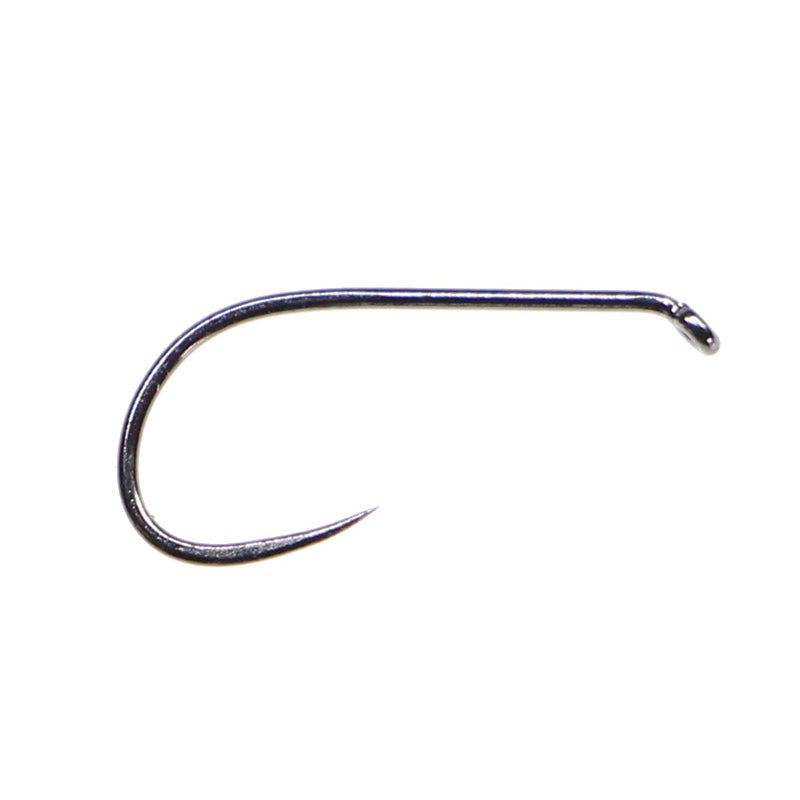
This one has nothing to do with hackle directly, but it undermines all the hackle work and gets overlooked because the hook is the last thing most tyers question. Heavy-wire hooks — designed for nymphs, wet flies, and streamer patterns — add dead weight that hackle simply cannot overcome on a standard dry fly. A size 14 nymph hook and a size 14 dry fly hook are not interchangeable. The wire gauge is different and the weight difference is decisive for surface presentation.
Dry fly hooks use fine wire specifically to minimize weight and maximize flotation. If a fly is tied on the correct hook and still sinks despite correct hackle selection, sizing, and application — check the hook.


The floatant question
Floatant is a maintenance tool, not a fix for tying problems. A well-tied dry fly on quality genetic hackle will float without floatant for several casts. Floatant extends that performance, repels water after a fish has worked the fly over, and helps revive a fly that's been soaked — but it cannot keep a poorly tied fly on the surface indefinitely.
If a fly requires floatant immediately on the first cast to stay afloat, the tying is the issue. Work back through the five problems above before reaching for the bottle.
Building a dry fly bench that actually floats starts with the right hackle. Browse capes, saddles, and hen from Whiting Farms, Keough, Metz, Ewing, and more:
Comments
Sorry my english is very poor,but since i discovered your company,i’ve made some great finds and purchased quality equipment. My only problem is that my english doesn’t allow me to speak to you directly on phone. Also,l’m from Quebec,shipping and customs fee Make purchases expensive and complicated. Thank you for keeping us informed
Best regards. Alain Gaudreault