


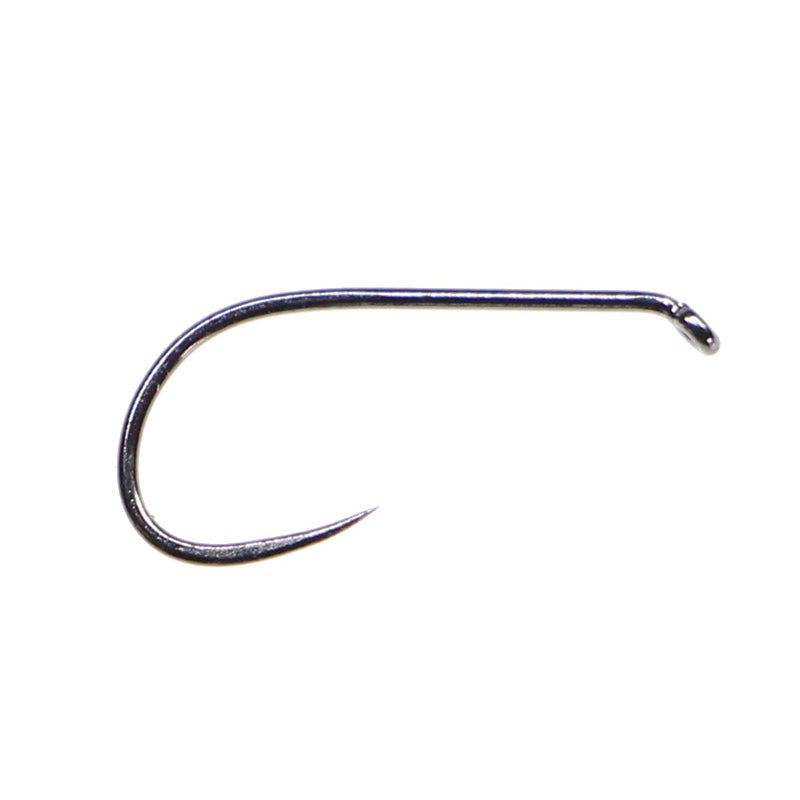


Most fly tyers select hooks based on size and style alone, without fully understanding the nuanced anatomy that makes each hook perform differently in a fly. Read on:
The Essential Components Of Fly Tying Hooks
The Eye
The eye is where your tippet or leader connects to the hook, and its orientation significantly affects fly presentation. Up-eye hooks (common in dry flies) help the fly ride higher on the water's surface. Down-eye hooks are versatile workhorses used in nymphs and wet flies, while straight-eye hooks offer neutral positioning ideal for streamers and certain specialty patterns.
The eye's shape matters too. Ring eyes are standard, but looped eyes provide extra strength for larger patterns.
The Shank
The shank is the straight section between the eye and the bend. Its length dictates your fly's profile and silhouette. Standard shank hooks match traditional proportions, while long shank hooks (2X, 3X, or even 4X long) let you tie extended-body patterns like streamers and damselfly nymphs. Short shank hooks are perfect for compact patterns like scuds and eggs.
The shank's weight also varies. Standard wire works for most applications, but heavy wire (2X or 3X heavy) helps nymphs sink faster and is needed for toothy critters, while light wire (1X or 2X fine) keeps dry flies floating delicately.
The Bend
The bend is where the hook curves, and it's crucial to hook-setting success. Round bends offer classic proportions and reliable hooking. Wide gape bends create more space between the point and shank, improving hook-up ratios on short strikes or oddly shaped patterns such as crabs and crustaceans. Continuous bends flow smoothly from shank to point, while offset bends feature a slight twist that can improve penetration.
Popular bend styles include:
- Sproat bend: Wide and round, excellent for dry flies
- Aberdeen bend: Long, sweeping curve with light wire, perfect for live bait and delicate presentations where you want minimal damage
- Round bend: Classic semicircular shape, versatile for nearly any pattern from dries to nymphs
- Bend Back: Sharp reverse angle that brings the point back toward the shank, designed for weedless fishing through heavy cover
- Limerick bend: Gradual curve, great for wet flies and nymphs
- York bend: Tighter curve, ideal for smaller patterns


The Point
The business end of any hook, the point must penetrate quickly and hold securely. Needle points are extremely sharp but can dull quickly. Spear points offer a good balance of sharpness and durability. Rolled points turn slightly inward for better penetration, while hollow points create a cutting edge that slices through tough jaw tissue.
Premium hooks often feature chemically sharpened points that are sharper than mechanically sharpened alternatives and maintain their edge longer.
The Barb
The small projection below the point, the barb prevents the hook from backing out. While traditional barbed hooks offer security, many trout anglers prefer barbless hooks or pinch down barbs for easier catch-and-release (and hook removal should you pin yourself or your boat buddy!). Micro-barbed hooks split the difference, offering some holding power with less fish damage.
The Gape
The gape is the distance between the point and the shank. The 'gap' in essence. Wider gapes improve hooking percentages, especially on fast-striking fish or patterns with bulky bodies such as crab and crustacean patterns. Narrow gapes work well for sparse patterns where you want the hook to remain subtle but you might compromise on hook-up rates. Gape is an on-going debate among fly-fishers and one of those things that comes down to confidence... You know what we mean - fish something with confidence and it works.
Matching Hooks to Patterns
Understanding anatomy helps you select the perfect hook for each fly. Delicate mayfly emergers demand light-wire, wide-gape hooks with up-eyes. Weighted stonefly nymphs need heavy-wire, long-shank hooks with down-eyes. Streamers benefit from stout, straight-eye hooks with generous gapes. Now is a great time to stock up on Fly Tying Hooks: